

Key Stakeholders: Shareholders, Farmers, Employees, Suppliers, Customers and Consumers, Communities,
Government and Civil Society Sectors
Effective supply chain management generates positive impacts and strengthens business operations over the long term. Therefore, the Company is committed to managing its supply chain effectively by establishing the Sustainable Procurement Policy, the Agricultural Raw Materials Sourcing Policy and Mitr Phol Supplier Code of Conduct. The Company also has a supplier screening and selection process that incorporates sustainability criteria to identify suppliers whose standards and sustainable business practices align with the Company’s requirements. In addition, the Company engages suppliers through awareness-raising initiatives to encourage greater consideration of environmental and social impacts in their operations and fosters collaboration through joint projects that promote sustainable development.
|
|
Target
|
Performance
|
|---|---|---|
|
The significant suppliers are assessed for sustainability risks
(ESG Assessment) (ESG Assessment) |
100%
|
80.09%
|
Mitr Phol's suppliers are classified based on their roles and the products and services they provide. This categorization ensures the appropriate and efficient management of each supplier category. Suppliers are divided into two main categories, as detailed below:

Central suppliers
Central suppliers provide goods and services that support the Company's operations. This category includes domestic and international contractors, including suppliers of chemicals and packaging materials.

Raw materials suppliers
Raw material suppliers provide key raw materials for the Company's production processes. This supplier category includes sugarcane, rubber, and cassava farmers, and suppliers of molasses and biomass fuel.
The Company classifies significant suppliers based on procurement spending and the criticality of the products or services provided, enabling the Company to develop effective supplier management plans and strategies. The criteria for identifying significant suppliers are as follows:
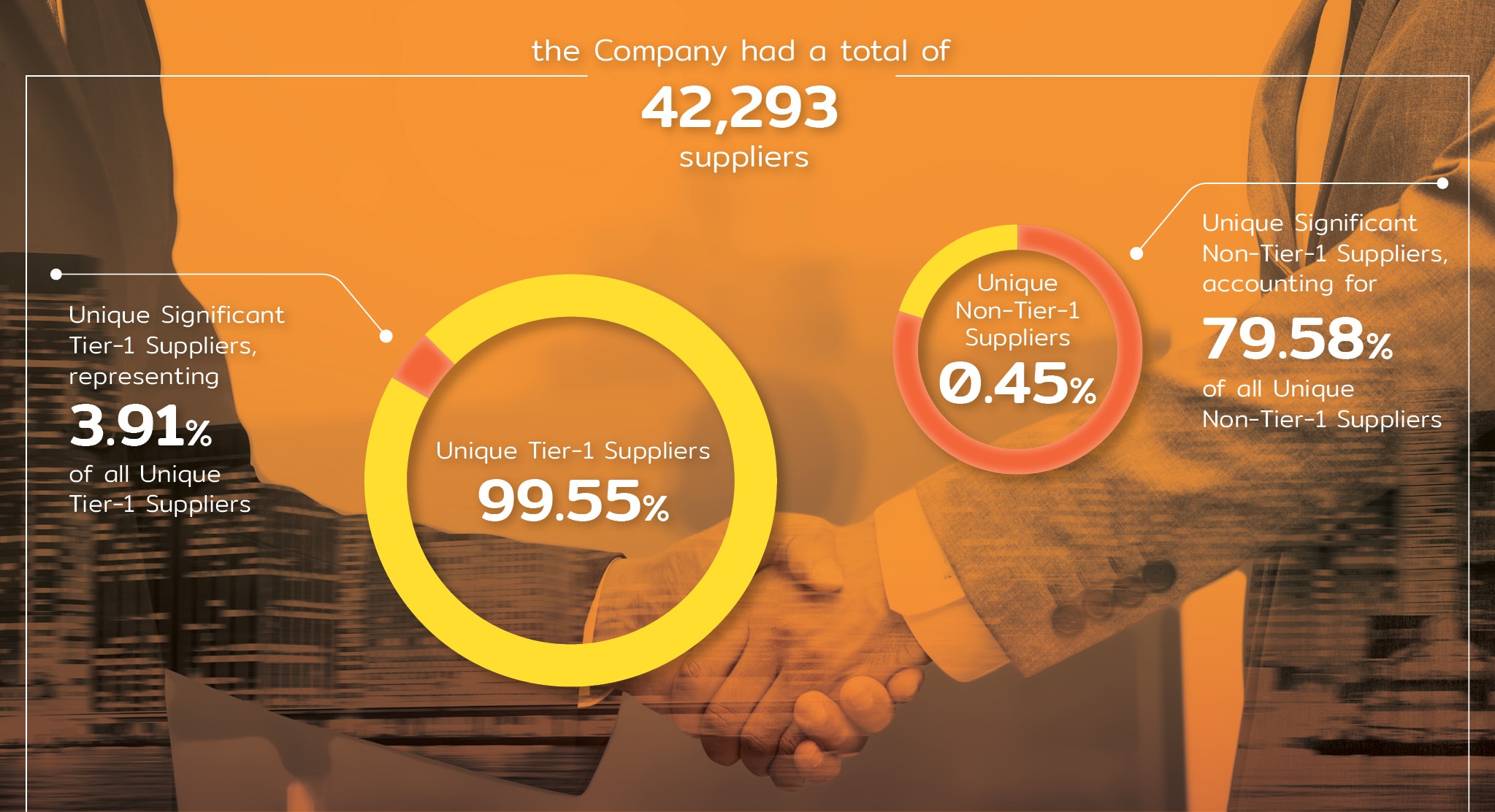
In 2025, the Company had a total of 42,293 suppliers, comprising 42,102 Unique Tier-1 Suppliers, accounting for 99.55%, and 191 Unique Non-Tier-1 Suppliers, accounting for 0.45%. Among these, 1,646 were classified as Unique Significant Tier-1 Suppliers, representing 3.91% of all Unique Tier-1 Suppliers, while 152 were Unique Significant Non-Tier-1 Suppliers, accounting for 79.58% of all Unique Non-Tier-1 Suppliers.
Mitr Phol has established the Sustainable Procurement Policy, the Agricultural Raw Materials Sourcing Policy, and the Mitr Phol Supplier Code of Conduct as guidelines for employees and suppliers. These serve as operational standards for both employees and suppliers, addressing key areas related to corporate governance, social responsibility, and environmental stewardship. Topics include business ethics, respect for human rights, fair labor practices, including prohibitions against forced labor, child labor, and illegal labor, maximizing the efficient use of natural resources, and grievance channels. These policies are communicated through various channels, and the Company actively audits and monitors supplier compliance. All suppliers are required to acknowledge and accept the Mitr Phol Supplier Code of Conduct by signing it before entering into a business relationship with Mitr Phol.
In 2025, the Company conducted the annual ESG Assessment covering 1,440 Unique Significant Tier 1 and Non-Tier 1 Suppliers, representing 80.09% of total Unique Significant Suppliers, through an initial ESG risk evaluation (Desk Assessment) consisting of self-assessment or on-site assessment by the Procurement Division or Material Sourcing Section. Among the suppliers assessed, 246 Unique Significant Suppliers were identified as having high sustainability-related risks, all of which were covered by Corrective Action Plans, and all of them (100%) participated in a Corrective Action Plan. No business relationships with suppliers were terminated as a result of the assessment. In addition, the Company provided an ESG Development Program for 430 Unique Significant Suppliers, representing 23.92% of all Unique Significant Suppliers included in ESG risk assessment.
In addition, the Company has established an annual process for monitoring and evaluating supplier performance. This process includes assessments of the quality and standards of products and services, as well as reviews of suppliers’ sustainability-related risks through ESG Assessments. The Company regularly reviews its procurement practices in relation to suppliers to ensure the operation is aligned with the Supplier Code of Conduct. These practices support suppliers to effectively comply with the Company requirements and avoid potential conflicts with ESG requirements as well as to mitigate risks related to product quality, supply chain disruptions, and other relevant risks.
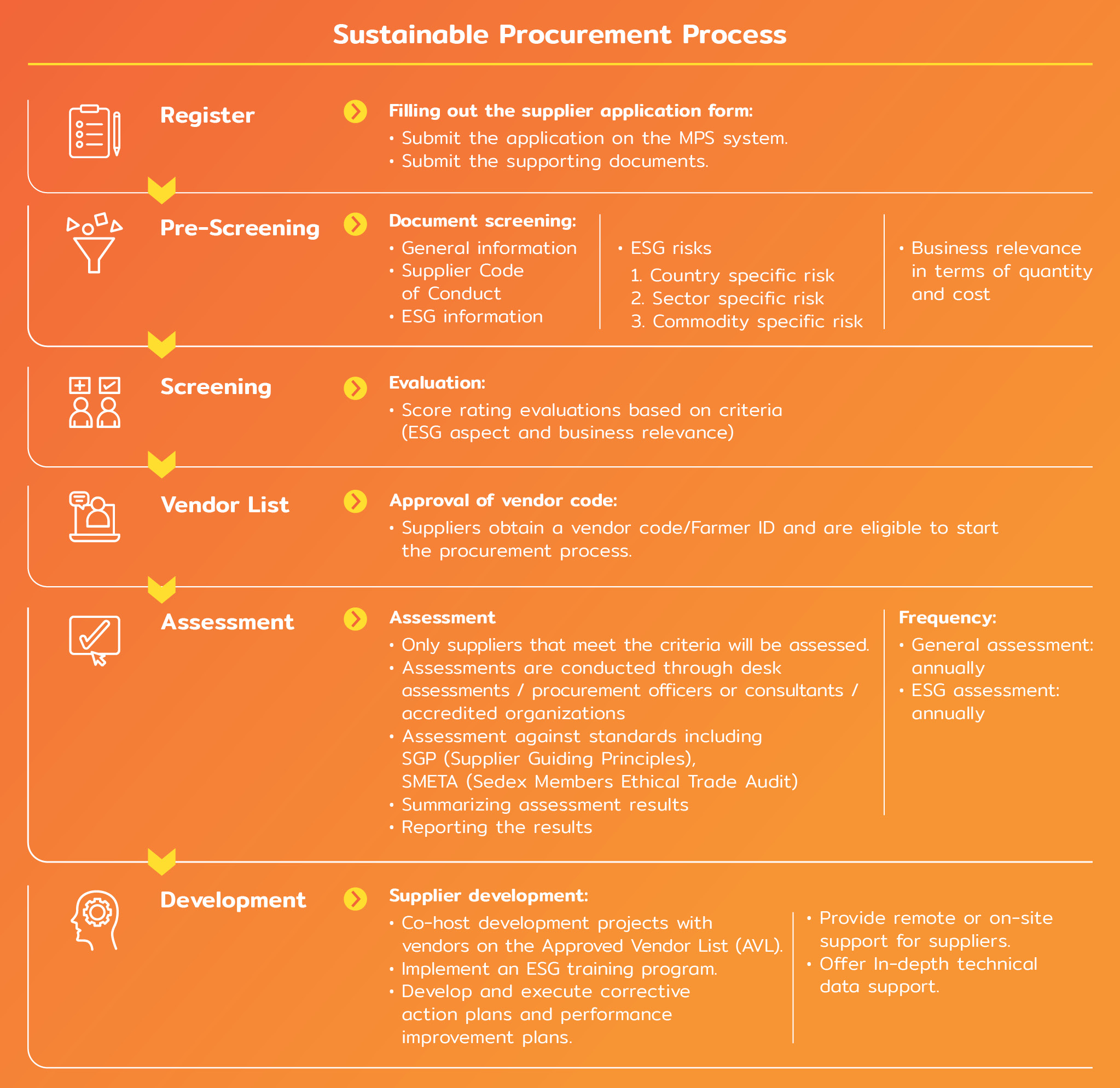
Supplier performance is evaluated annually through self-assessments using questionnaires, desk assessment or 2nd party on-site assessment by the Procurement Division and Sustainable Development Division, as well as 3rd party on-site assessment such as the Standard for sustainable sugarcane production (Bonsucro and VIVE Programme), the Supplier Guiding Principles (SGP), and the Sedex Members Ethical Trade Audit (SMETA). Assessment results are communicated to suppliers via email or other designated channels. Suppliers may also compare their results against other suppliers within the same industry group, enabling them to continuously improve their business operations. If a supplier is found to be in breach of the Supplier Code of Conduct, such as human rights violations, negative environmental impacts, or a lack of good corporate governance, the Company will issue a warning, outline a corrective action plan with a specific timeline, and closely support and monitor progress. Failure to comply with the minimum ESG requirement may result in penalties, including contract termination and permanent removal from the Company's approved supplier list.
Moreover, suppliers with better ESG performance/score are more likely to be selected, as sustainability risk criteria are incorporated into the Company's supplier selection process. At present, ESG assessments are conducted for Significant Tier-1 suppliers, including those providing chemicals and packaging and Significant Non-Tier-1 Suppliers including rubber farmers.
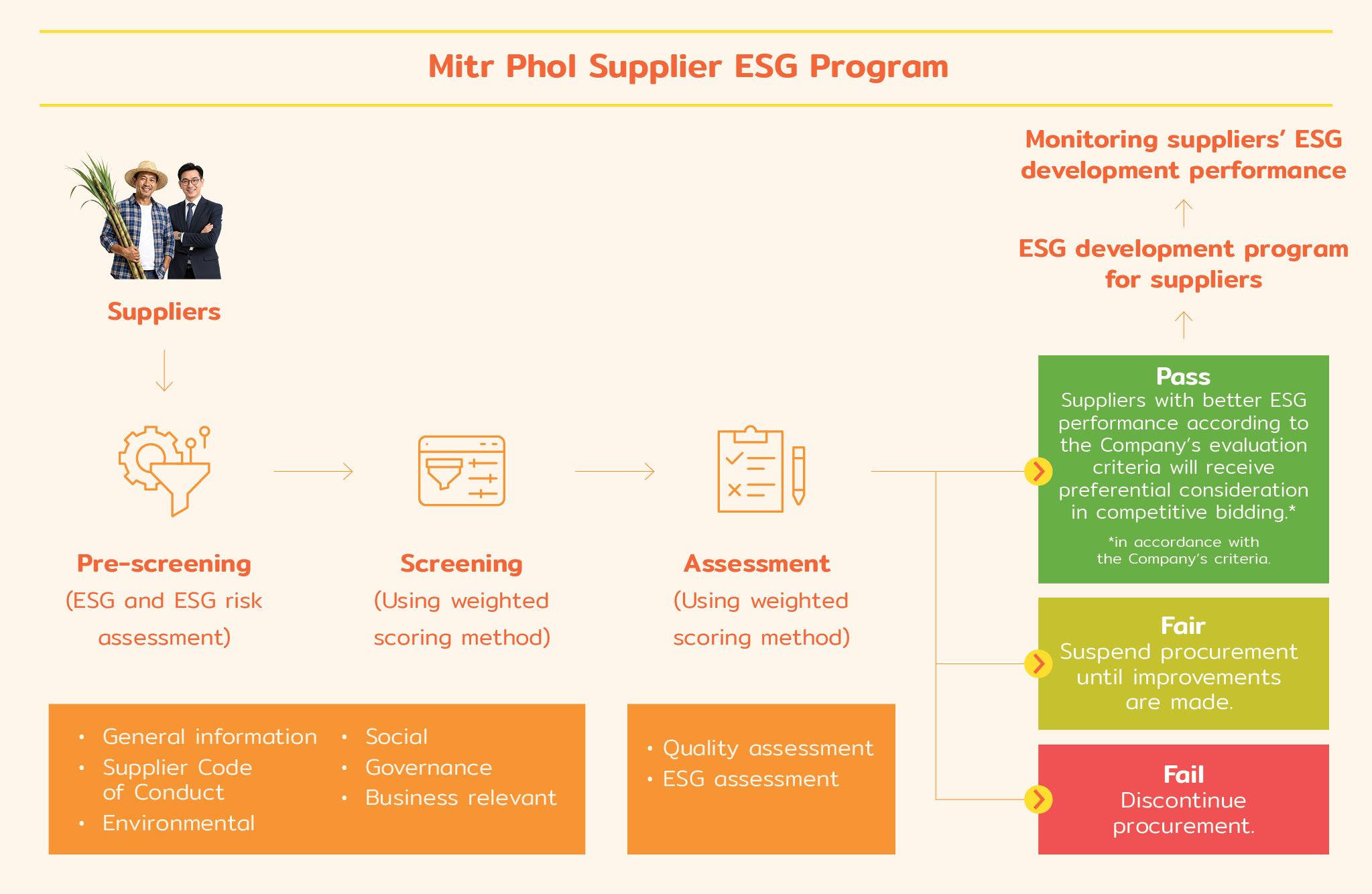
Suppliers should operate their businesses in alignment with the Mitr Phol Supplier Code of Conduct and be aware of ESG principles. Suppliers with better ESG performance, according to the Company’s evaluation criteria, will be granted privileges/ special benefits such as special awards, certificates of recognition, being named a “Model Farmer”, receiving extra points in selection process or being awarded contracts with the Company (in accordance with the Company’s criteria). Suppliers who do not meet the minimum evaluation score must improve their performance and submit evidence of improvement to the Company. The Company will then consider and unlock their status
The implementation of this Supplier ESG Program is overseen by the Sustainability Committee.
The Mitr Phol Procurement System (MPS) is a platform for purchase requesters, procurement personnel, and Mitr Phol Group’s suppliers to track purchase order status, receive real-time communications and update, and facilitate supplier performance evaluation upon completion of product delivery or service provision. Data from the MPS is integrated with the SAP system (Systems, Applications, and Products in Data Processing), facilitating audits, enhancing transparency, streamlining workflows, and ensuring full traceability across the entire procurement process. This integration also enhances resource utilization and cost management efficiency. For food contact materials (FCMs) that may affect food safety, such as chemicals used in production processes and packaging materials, the MPS tracks product quality, manufacturing origin, production origin, and transportation safety upon receipt of goods from suppliers. If the delivered items fail to meet the required specifications or pose any food safety risks, suppliers are required to correct the non-conformities within a specified timeframe.
The Company enhances procurement employees’ knowledge and understanding of sustainable business practices through sustainability training tailored to their respective roles and responsibilities and covering environmental, social, and governance (ESG) topics. In 2025, the Company conducted sustainability training on the Mitr Phol Supplier Code of Conduct, the Sustainable Procurement Policy, greenhouse gas emissions reduction approaches supporting Mitr Phol’s Net Zero Pathway, andthe ESG risk assessment process for suppliers under the Mitr Phol Supplier ESG Program.
