Mitr Phol Group Sustainability

Edit Template

Sustainable Development Policy

Mitr Phol conducts its business with due consideration for sustainability across three dimensions: environmental, social, and governance (ESG). To ensure the Company’s operations are aligned toward a common direction and shared goals, as well as with the United Nations Sustainable Development Goals (SDGs), the Board of Directors has approved and formally adopted the Sustainability Development Policy. The policy is reviewed and updated annually to ensure that it remains current and appropriate in light of evolving global circumstances and international sustainability principles. This enables all businesses across Mitr Phol Group to translate the policy into concrete actions. The policy is also communicated to internal and external stakeholders through a variety of communication channels.

Social

Sustainable Communities

Governance

Transparent and Collaborative Organization

Information on Environment

To Support a Thriving Environment

Sustainability Management Structure

Mitr Phol has established a sustainability management structure to drive concrete, clearly defined, and effective sustainable development efforts. The Board of Directors has appointed and entrusted
the Sustainability Committee with overseeing the Company’s sustainable development operations.
The Committee meets quarterly and has been assigned the following roles and responsibilities:

  1. Establish policies, goals, and strategies and consider the organization’s environmental, social, and governance risks and opportunities to ensure alignment with business strategies and goals, applicable laws, international best practices, and national and global sustainability trends.

  2. Consider and review operational frameworks, oversee the environmental, social, and governance performance of business units, and provide recommendations to ensure that ESG considerations are integratedinto business processes and objectives.

  3. Promote, advise, and support the implementation of environmental, social, and governance strategies throughout the organization while driving continuous improvement.

Executive Vice President - Corporate Sustainability Management serves as the highest-ranking executive responsible for Corporate Sustainability. The role is responsible for promoting, supporting, and collaborating with other departments across Mitr Phol’s business units. This helps ensure organization-wide alignment with the policies and guidelines established by the Sustainability Committee. These efforts ensure alignment and a consistent direction throughout the organization, support the achievement of established goals, and address the needs of all stakeholders.
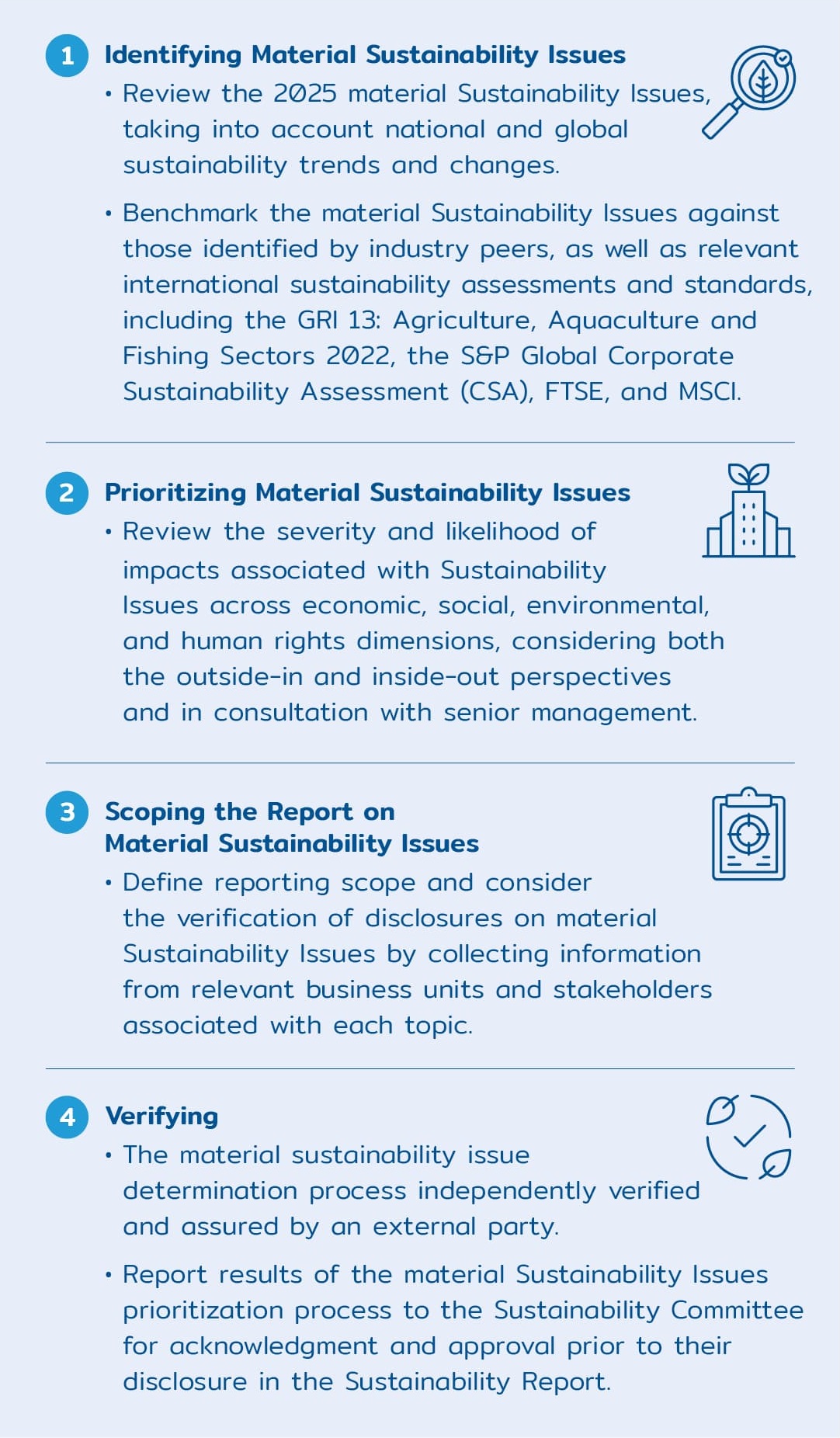
Identifying Material Sustainability Issues

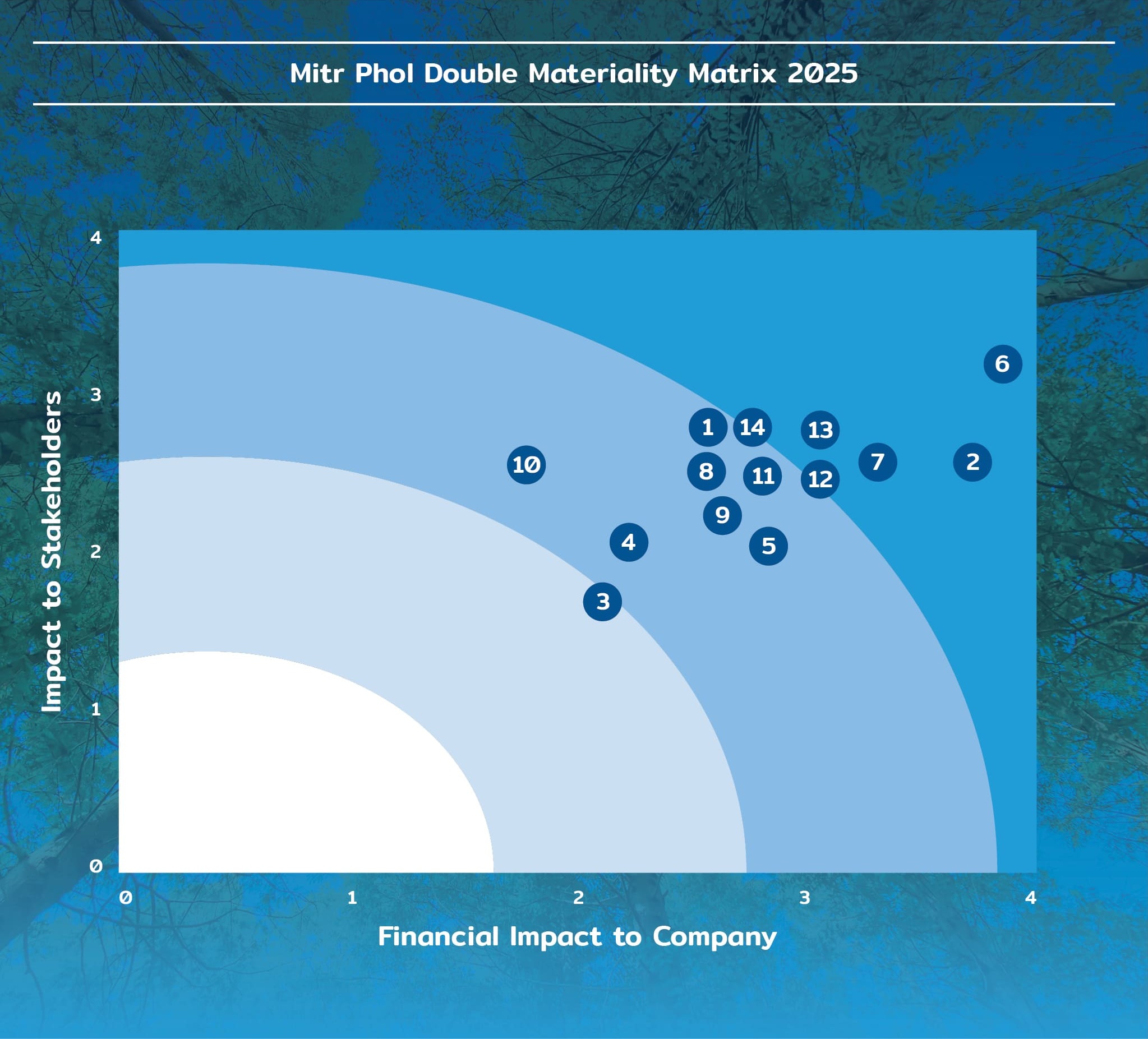
Mitr Phol conducts an annual review and assessment of material sustainability issues in accordance with the double materiality principle. The 2025 assessment began with a review of Mitr Phol’s material sustainability issues benchmarking them against topics identified by industry peers and relevant international sustainability assessments and reporting standards, including GRI Standard: Agriculture, Aquaculture and Fishing Sectors 2022. The assessment also took into account national and international sustainability trends and developments. All material by applying the Enterprise Risk Management (ERM) process and assessment criteria to determine the severity and likelihood of impacts arising from Mitr Phol’s business activities and business relationships across corporate governance, social, and environmental dimensions. The double materiality assessment considers two perspectives:
  • Outside-in Perspective
    Assesses sustainability-related risks and opportunities that may affect the Company, including impacts on its reputation and brand image, financial condition, market competitiveness, and value creation.
  • Inside-out Perspective
    Assesses the Company’s actual and potential positive and negative impacts on stakeholders through the stakeholder engagement process. Stakeholders participating in the assessment include shareholders, farmers, communities, suppliers, customers and consumers, employees, government agencies, and civil society organizations. The assessment is conducted through various methods, including questionnaires, interviews, and secondary data analysis.
The assessment results are prioritized and used to formulate operational guidelines that address stakeholder needs and align with the Company’s business context, ensuring a comprehensive approach to business management.

Material Sustainability Issues

  1. Corporate Governance and Risk Management
  2. Supply Chain Management
  3. Digitalization and Technology
  4. Innovation
  5. Product Quality and Safety
  6. Climate Strategy
  7. Water Management
  8. Circular Economy
  9. Biodiversity
  10. Air Quality
  11. Health and Safety
  12. Community Relations
  13. Labor Practices and Human Rights
  14. Human Capital Management

Memberships and Engagement with External Organizations

Mitr Phol promotes the development of both national and international networks to strengthen collaboration and create an environment that supports dialogue and knowledge exchange. These efforts aim to improve operational efficiency and drive the development of products and services that respond to market and societal needs. The Company also plays an active role in supporting and driving the development of policies and regulations that encourage sustainable business practices. Mitr Phol partners with organizations and institutions dedicated to advancing sustainable development in areas aligned with the Company’s business strategy, with two primary objectives:

  1. To support and drive the development of the sugarcane, sugar, and bio-energy industries in Thailand, Mitr Phol is a member of relevant trade and industry associations. These memberships support appropriate industry governance, facilitate knowledge exchange, promote the stability of the sugar industry in terms of supply and prices, and advance the production of renewable energy through the processing of agricultural products. The Company also seeks to create business opportunities across the sugarcane, sugar, and renewable energy industries, including related downstream products, while promoting fair benefit-sharing and generating income for farmers and stakeholders throughout the supply chain. These efforts help establish and maintain the security and reliability of the Company’s raw material supply. In 2025, Mitr Phol provided financial support totaling 8.87 million baht, representing 87.43% of its total grant budget.

  2. To support Thailand’s sustainable development, Mitr Phol is a member of and serves on the governing bodies of associations and institutions dedicated to advancing research and the country’s sustainable development. Through these engagements, the Company supports initiatives related to climate change management, respect for human rights, and the Sustainable Development Goals (SDGs). The Company also supports and contributes to the development of greenhouse gas emissions reduction policies and approaches aimed at achieving net-zero greenhouse gas emissions. In 2025, Mitr Phol provided financial support totaling 1.28 million baht, representing 12.57% of its total grant budget.

Further details on Mitr Phol Group’s memberships and engagement with external organizations are available in the Mitr Phol Sustainability Report 2025.

Related Policy and Statements

Sustainable Development Policy