


Key Stakeholders: Shareholders, Employees, Communities, Customers and Consumers,
Government and Civil Society Sectors
|
Indicators
|
Target
|
Performance
|
|---|---|---|
|
Receipt of serious environmental complaints*
|
No serious environmental complaints received*
|
No serious environmental complaints received*
|
|
Water consumption reduction compared with the baseline year 2022
|
Decreased by 4% annually
|
increased by 20.50%**
from the baseline |
The Board of Directors has established a policy on Security, Safety, Occupational Health, and the Environment* and has allocated the necessary resources to support the development of preventive, monitoring, and corrective measures, as well as the inspection of environmental systems. Each factory has a dedicated environmental unit responsible for implementing policy, environmental aspects, and risk assessment. In addition, the units are responding on implementing measures, providing environmental knowledge, awareness-raising activities, and promoting environmental conservation to relevant stakeholders through monthly meetings that are convened between factory management and the Occupational Safety, Health, and Environment (OSHE) Committee. Additionally, meetings with senior management from the business groups are held at least once a month to monitor safety and environmental issues, and exchange views. For large factories, the Company has established a tripartite committee and a Community Committee for power plants with a capacity not exceeding 9.9 MW. These committees, comprising representatives from factories or power plants, the government sector, and communities, serve as a platform for sharing opinions and offering recommendations to improve the effectiveness of the environmental management system effectively.
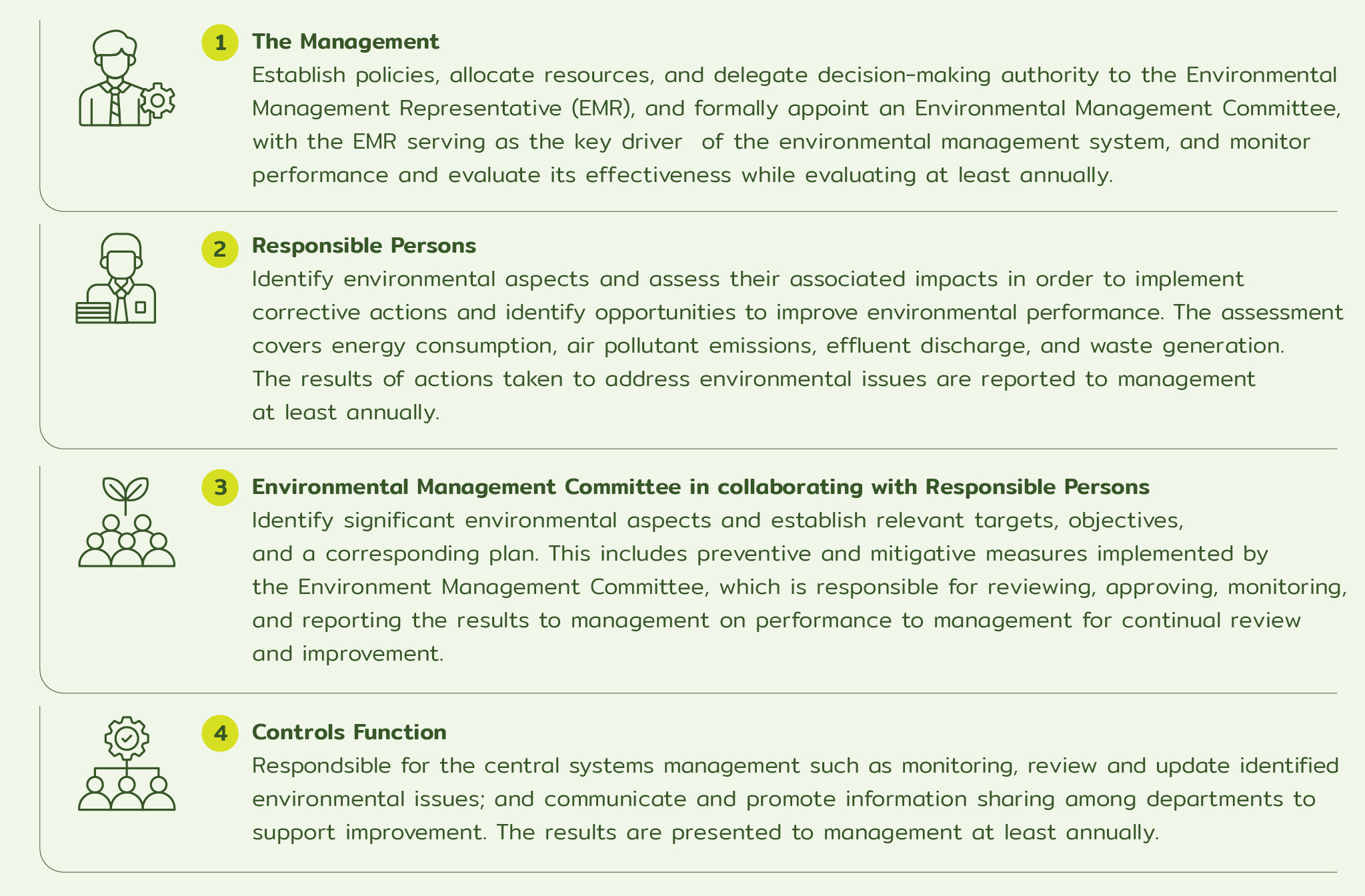
The Company manages its environmental performance in accordance with ISO 14001, the international standard for environmental management systems (EMS). The system encompasses policy setting, planning, risk assessment, the establishment of preventive and mitigation measures, and the continual review and improvement of environmental performance. This enables the Company to appropriately prevent and mitigate environmental risks and impacts while strengthening stakeholder confidence. Mitr Phol personnel have the following environmental roles and responsibilities:
The Company has established requirements to analyze the impact of water usage and the water dependency of business activities from upstream to downstream, using a tool called ENCORE (ENsemble for CO-Re-Analysis), as well as assessing water availability risk and water quality risk using the WWF Biodiversity Risk Filter (WWF BRF), to enable the Company to prevent and prepare for the impacts of water-related risks on its business, and to plan appropriate management accordingly. In addition, the Company studies the potential impact of El Niño and La Niña on sugarcane yield, by considering precipitation and rainfall forecasts from the Meteorological Department, to assess water availability and develop efficient water management in the fields. (For further details, please refer to the Farm Management chapter)
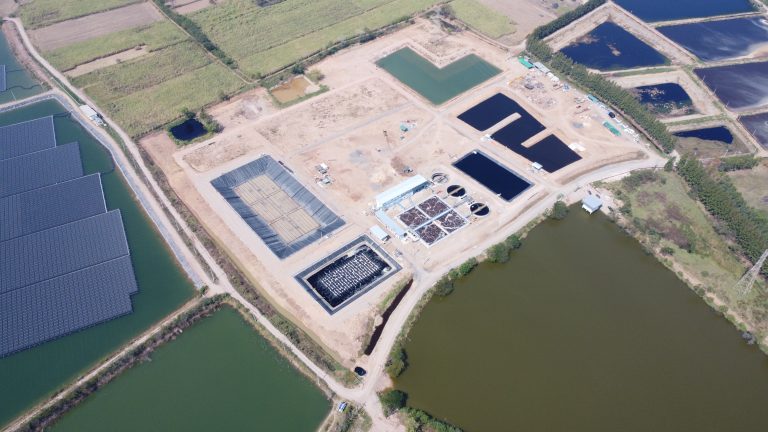
The Company requires all wastewater generated from its production processes to be treated through appropriate treatment systems, including the Upflow Anaerobic Sludge Blanket (UASB), Oxidation Pond, and Activated Sludge systems, to ensure compliance with applicable effluent discharge standards and minimize environmental impacts. To enhance wastewater treatment efficiency, the wastewater treatment systems at the Mitr Phu Khiao Complex and Mitr Phol Dan Chang Complex have been upgraded to Activated Sludge systems, with plans to expand the installation to other manufacturing sites in the future. In addition, the Company applies the 4Rs principles to enhance water management efficiency and reduce water-related impacts. Further information on the Company's 4Rs approach to water management is available in the Mitr Phol Sustainability Report 2025.
1.) Air quality monitoring: The Company proactively manages air quality under the concept "Know Before the Community, Act Before Impact," through the installation of the AERMODEL system and IoT sensors to monitor wind direction and wind speed, and to measure air quality in areas surrounding its factories, including PM2.5 and PM100. Currently, the sugar mills and factories located within the same area, Panel Plus Co., Ltd. (Hat Yai factory) and Mae Sot Clean Energy Co., Ltd. have installed advance wind forecast notification systems to determine impact mitigation measures according to weather conditions.
In addition, the weather forecast and meteorological data are analyzed to determine mitigation measures for both daily and long-term pollution-source activities, in order to reduce impacts on communities for example, by activating dust-trapping sprays at high-risk areas and avoiding potentially pollution-emitting activities during critical periods. In 2025, Sing Buri Sugar Mill conducted a pilot study on the application of artificial intelligence (AI) to improve the accuracy of wind forecasting. This initiative enabled the mill to prevent and manage dust emissions more precisely through the development and installation of an automated system and equipment to manage pollution sources in alignment with wind direction data. Particulate matter (PM) levels were used as a key indicator to evaluate the effectiveness of dust prevention measures. As a result, the mill enhanced its ability to control and mitigate dust-related impacts, leading to more effective pollution prevention and control.
2.) Prevention and Control of Pollution at Its Source
3.) Air Quality Monitoring
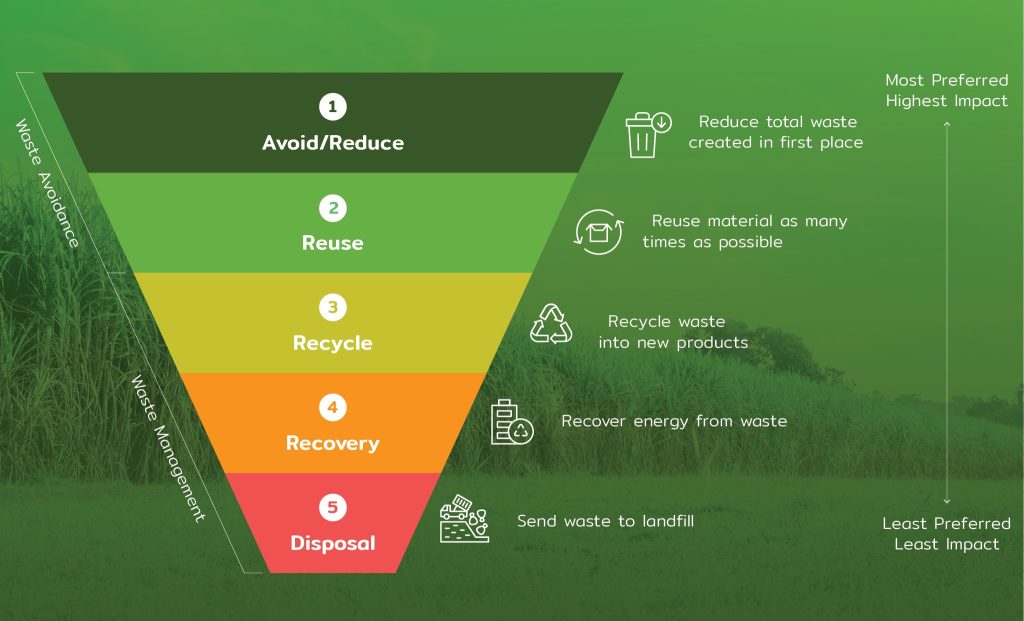
With a strong commitment to advancing Thailand’s agricultural sector under the concept “From Waste to Value Creation,” Mitr Phol utilizes waste from one business is continuously transformed to create value for another. For example, bagasse is converted into biomass-fueled electricity, molasses is processed into ethanol, and filter sludge and distillation effluent are used to produce fertilizer as well as developing bio-based products to reduce waste. The Company has established its waste management strategy based on the waste hierarchy concept, which consists of avoidance/reduction of waste generation, reuse, recycle, recovery and disposal.
Mitr Phol Dan Chang Complex has piloted a study on a data collection system for waste profiles, covering waste type, quantity, and management methods in accordance with environmental standards, to serve as a database for determining waste management and reduction approaches, alongside developing a Closed-loop Recycling system with partners. In addition, the Company is studying third-party certification of waste diverted from landfill for other beneficial uses instead of disposal, to build transparency and enhance waste management with sustainability approaches.
ISO 14001 and ISO 45001 Standards Training
Mitr Phol provides training on the Environmental Management System (ISO 14001) and the Occupational Health and Safety Management System (ISO 45001) for relevant personnel to strengthen their knowledge of occupational health, safety, and environmental management. The training also covers waste management practices, including waste segregation, the proper use of waste bins, and appropriate disposal methods for different waste categories, enabling employees to apply this knowledge in both their work and daily lives. In addition, Mitr Phol has successfully achieved Multi-site One Certification for its sugar mills and biomass power plants, covering both the Environmental Management System (ISO 14001) and the Occupational Health and Safety Management System (ISO 45001). The Company plans to further expand the certification scope to include Mitr Phol Kaset Somboon Sugar Mill in Chaiyaphum Province.
Waste Reduction Training
Mitr Phol provides employees with waste reduction training tailored to the specific context of each factory. The training covers waste segregation, including general waste, recyclable waste, and hazardous waste, as well as the repurposing of by-products as soil conditioners. Following the training, employees apply their knowledge in practice through activities such as sorting recyclable waste for resale, producing compost and bio-liquid fertilizer, and collecting UHT cartons for donation to be transformed into the recycle roofing materials.
Mitr Phol has provided internal training at its factories on utility water management and wastewater treatment. The training covers measures to reduce and control water use and optimize water efficiency, such as using treated water to irrigate plants, ensuring that taps are fully turned off after each use, selecting water-efficient sanitary fixtures, and checking sanitary equipment for leaks. It aims to raise employees' awareness on the importance of water resources and promoting efficient water management. In addition, In addition, selected employees participate in external training on Water Footprint assessment, to strengthen their capabilities in sustainable water management.
Mitr Phol remains committed to continuous research and to add value to residual materials and use innovation to reduce waste disposal through landfill. Key ongoing projects include:
Security, Safety, Occupational Health, and Environment Policy
